The History of Bath Press
The History of Bath Press
From Sir Isaac Pitman’s Vision to a Landmark Bath Address
Discover how a pioneering Victorian printing institute grew into one of Bath’s most important industrial sites before being transformed into a remarkable new residential community.
Few developments can claim a history as rich and influential as Bath Press. Situated on Lower Bristol Road within the city’s UNESCO World Heritage Site, the former printing works has witnessed more than a century of innovation, industry and change. Today, the beautifully restored apartments and townhouses at Bath Press offer a unique opportunity to live within a landmark that played a significant role in shaping both Bath’s industrial heritage and the wider world of publishing.
The Vision Of Sir Isaac Pitman
The story of Bath Press begins with Sir Isaac Pitman, the renowned educator and inventor of Pitman shorthand. Born in Trowbridge in 1813, Pitman developed a phonetic system of shorthand that revolutionised business communication and became widely adopted throughout Britain and beyond.
After moving to Bath in 1839, Pitman’s growing publishing business rapidly expanded. What began as a small educational enterprise operating from his home soon outgrew several premises across the city. As demand for his shorthand publications increased, larger facilities became essential.
In 1889, Pitman established his Fifth Phonetic Institute in Twerton, just beyond Bath’s city boundaries. This purpose-built facility would become the foundation of what later evolved into the famous Pitman Press and, eventually, Bath Press.
From Orchard to Industrial Landmark
The site itself was very different in the late nineteenth century. Ordnance Survey maps from 1882 show the area as an orchard, with nearby maltings and St Peter’s Church serving the expanding East Twerton community.
The arrival of the railways transformed the character of the area. With the Great Western Railway arriving in 1840 and further railway expansion during the late nineteenth century, Bath experienced rapid industrial growth. East Twerton became one of the city’s key manufacturing districts, providing employment for thousands and helping establish Bath as more than simply a fashionable Georgian spa town.
The Pitman Institute was perfectly positioned within this thriving industrial landscape. As the publishing business grew, additional buildings were added across the site, gradually transforming the former orchard into a substantial printing complex.
The Expansion of Pitman Press
The original institute did not remain unchanged for long. Throughout the early twentieth century, the site underwent significant expansion as printing operations increased.
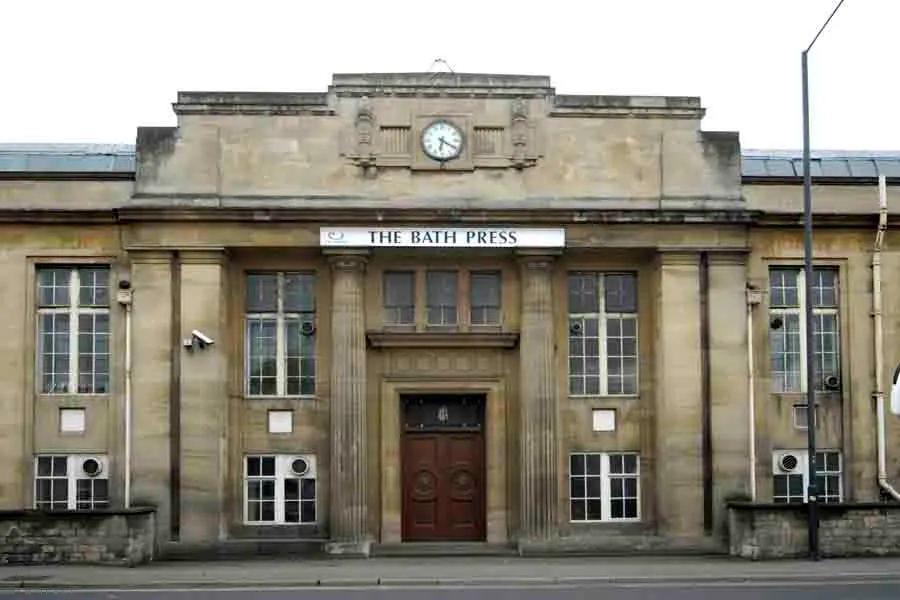
The impressive stone frontage seen today was constructed in phases between the late nineteenth century and 1926. Combining Classical and Art Deco influences, the façade became a defining feature of Lower Bristol Road and remains one of the site's most recognisable architectural elements.
Among the architects who contributed to the development was Sir George Oatley, best known for designing Bristol’s Wills Memorial Building. Oatley designed the distinctive triple-bay entrance and the vaulted office building behind it, which was affectionately known as “The Ballroom”. Additional sections were designed by local architect C. Bryan Oliver, creating a cohesive yet evolving architectural statement that reflected the company’s continued success.
By the 1930s, aerial photographs show a vast industrial complex occupying much of the site. The original institute had effectively been absorbed into a much larger operation, with printing facilities dominating the surrounding landscape.
Supporting the Nation Through Change
Following Sir Isaac Pitman’s death in 1897, the business continued to prosper. Pitman Press became one of Bath’s most important employers and helped cement East Twerton’s reputation as the industrial powerhouse of the city.
During the Second World War, the company adapted to support the national war effort. Alongside its publishing activities, the site incorporated an airscrew overhaul facility, demonstrating the flexibility and importance of the operation during a period of tremendous national challenge.
The business was incorporated as Museum Press Ltd in 1943, although it continued trading under the well-known Pitman Press name for many years.
The Birth of Bath Press
In 1985, the company officially adopted the name Bath Press, reflecting its strong connection to the city it had called home for almost a century.
For generations of local residents, Bath Press was a familiar landmark and a major source of employment. It sat amongst a network of industries that once defined East Twerton, including soap manufacturing, engineering works, railway yards, gas works and foundries.
The area’s industrial heritage remains an important part of Bath’s wider history, illustrating how the city evolved beyond its Georgian origins to become a centre of manufacturing and innovation.
A New Chapter Begins
After more than a century of operation, the printing works were vacated in 2008. Much of the site was subsequently demolished, but the historically important façade was preserved, ensuring that a key piece of Bath’s industrial heritage would remain for future generations.
Today, City & Country has carefully transformed the site into an exceptional collection of homes that celebrate both its history and its future. The restored façade serves as a lasting reminder of the site's remarkable past, while the contemporary apartments and townhouses provide a vibrant new chapter for this iconic location.
Bath Press stands as a testament to Bath’s ability to preserve its heritage while embracing regeneration. From Sir Isaac Pitman’s pioneering vision to the thriving residential community that exists today, the site remains an enduring symbol of innovation, ambition and transformation in one of Britain’s most beautiful cities.